Amber Sparks Reviews The Official Catalog of the Library of Potential Literature

I just picked up a copy of the latest issue of American Book Review and was happy to see that Amber Sparks reviewed The Official Catalog of the Library of Potential Literature. Sparks said this about my piece in the collection:

The writers included in the pages of The Official Catalog of the Library of Potential Literature do a great deal with one simple constraint. Some contributors, like John Madera with his very funny “Spectral Confessions and Other Digressions” (in which Slimer from Ghostbusters‘s musings appear alongside a drink recipe from Bloody Mary and “a delightful essay on financial management by Jacob Marley”), or Matt Bell with his piece on expanding possibilities, embrace the blurb form as starting point for a really good riff.
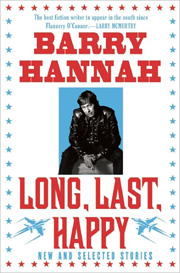
My Review of Barry Hannah’s Long, Last, Happy: New and Selected Stories Is Live

Check out my review of Barry Hannah’s Long, Last, Happy: New and Selected Stories at Rain Taxi: Review of Books, Online Edition: Summer 2011. Here’s an excerpt:

Reading through Long, Last, Happy, you can’t help but be struck by Hannah’s attentiveness to life as it’s lived by largely unlikeable characters, lively and unlovely—or perhaps lovely because of their liveliness. His fictional world offers readers a panoply of the grotesque, picturesque, and burlesque, a true variety show of shysters, wastrels, ne’er-do-wells, hacks, and failures; hideous schemers and beautiful dreamers; also musicians, soldiers, writers, and academics, not to mention racists and homophobes, each of whose fabulous foibles are incisively rendered in sentences which, without mincing words, make mincemeat of our hypocrisy, dishonesty, malice, violence, and other assorted failings, what Hannah, in “Dragged Fighting from His Tomb,” describes as that “bog and labyrinth” where we are all “overbrained and overemotioned.” It’s the kind of language, rendered as much with and for the eye as with and for the ear, that struck Hannah “as a miracle, a thing the deepest mind adores,” a musical language: an “orchestra of the living” accompanying “memory, the whole lying opera of it.”

Latest “A Reader’s Log(orrhea)” Column Is Live

Here’s an excerpt from my latest column:

You’ll find decades-long repressed memories dislodged in Micheline Aharonian Marcom’s The Daydreaming Boy, where eyebright prose perfectly puts across a distressed narrator’s unrestrained thoughts. Orphaned in the midst of Turkey’s massacre of the Armenians, Vahé Tcheubjian—through descriptions of unfulfilling trysts, brutal flashbacks, disturbing dreams, bizarre encounters with a monkey at the zoo, and imagined conversations with the mother who abandoned him—confronts his denials and ultimately challenges his very identity. Mirrors are Vahé’s tools for examining his past and its resultant pain, but it is the warped reflections of funhouse mirrors that he ultimately sees: distortions abound: here one stretches, this one condenses, and still another magnifies.

Review of Rikki Ducornet’s Netsuke

Check out my review of Rikki Ducornet’s Netsuke in the latest issue of American Book Review, alongside reviews by Gabriel Blackwell and John Domini. Here’s an excerpt of my review:

Rikki Ducornet’s Netsuke, where allusions to a panoply of gods and monsters abound, where some characters are, at times, avatars of those divinities, gives lie to the idea that intertextuality etiolates a narrative, chokes it beneath so much classical or whatever drapery, peoples it with cardboard cutouts for characters, relegating it into a facsimile of something far superior; these references serving, instead, as enriching threads woven within hefty narrative weft. Carefully limning the interstices between obsession, rage, desire, truth, and intimacy, as well as attentively traversing the planes of same, Netsuke castigates a life, and perhaps our society as a whole, in which Eros has gone awry, while also offering a cri de coeur against dubious psychiatric palliatives.