Category Archives: Uncategorized

Shya Scanlon Interview

Shya Scanlon interviewed me on Facebook:

Shya Scanlon: As an author, blogger and founder of Chapbook Review, you are a rare breed: someone who seems as comfortable reviewing fiction as you are writing it. Do you think authors have a responsibility to share, discuss, and promote work not their own? Do you personally feel a responsibility to do so?

John Madera: First of all, thanks for setting up this tiny interview series. Sometimes I think of Facebook as “Fakebook” so it’s great to see something that has a little more dynamism. As for all the stuff I’m up to, I feel like I’m at my best when I’m juggling all kinds of plates. They all intersect, play off of each other, and cross-pollinate.

As for responsibility, I think writers, in order to be called writers, must write. How often and how much, I wouldn’t presume to say or demand. I don’t think that a writer has a responsibility to share, discuss, and promote work that isn’t theirs. Writers who choose to work in total seclusion and isolation without a care for anyone else is fine with me; what matters is the quality of their work.

As for me, I feel it’s less a responsibility but more something that brings me great pleasure and teaches me so much.
Continue reading
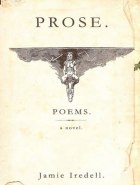
My Review of Jamie Iredell’s Prose. Poem. A Novel.

Check out my review of Jamie Iredell’s wonderful Prose. Poem. A Novel. at the Rumpus:

What I enjoyed most about Iredell’s narrative are his lyrical, almost Annie Dillard-like observations of nature, the elements, the landscape. But where Dillard’s evocations are solemn reveries sodden with all kinds of lushness, with prose akin to—[namecheck any American transcendentalist here]—Iredell’s descriptions are prickly, brittle, harboring all kinds of menace and malevolence.

My Interview with Chelsea Martin at The Rumpus

From the interview:

John Madera: When film director Pedro Almodóvar was asked if his movie Bad Education was autobiographical, he responded, “Everything that isn’t autobiographical is plagiarism.” So how much of your writing is autobiographical? How much do you distinguish fact from fiction and vice-versa in your writing? Would you talk about the various personas you adopt in these stories?

Martin: I basically have two ways I start writing. Either I’ll start with something about myself, or something that happened to me that seemed important, or I’ll start with some idea I have that doesn’t have much to do with me. But one will always lead to the other.

When something is finished, distinguishing “fact” from “fiction” is a matter of “the first part of that sentence really happened but it leaves out this important detail, and the second and fourth parts of that sentence also came directly from life, but the first and third parts came from some thoughts I had while watching a movie, and the sentence after it I just thought would be really funny.”

I mean, there is a lot of stuff I write that makes it seem like my intention is to make people think I’m speaking about myself entirely, and it is my intention to make people think that, but that doesn’t necessarily mean that’s what it is.

My Review of Gert Jonke’s The System of Vienna: From Heaven Street to Earth Mound Square at The Millions

From “A Crazy Trolley to Nowhere and Back Again: Gert Jonke’s The System of Vienna”:

With books that you planned to read this year still sitting on your shelf unread, and countless other recommendations swimming in your head, why should you even consider making room on your reading queue for a one originally published ten years ago in German and containing pieces dating back to 1970? But there is plenty fresh about Gert Jonke’s The System of Vienna: From Heaven Street to Earth Mound Square. Like the bulk of his work, this novel is musical, innovative, and difficult, not in a dusty academic way, but as a delightful puzzle, as a well-constructed argument, as a challenging game of chess. Thanks to Dalkey Archive Press, readers may now become acquainted with Gert Jonke’s work. Prior to Dalkey’s releases, Jonke’s books were unavailable in English. Having already published his Geometric Regional Novel and Homage to Czerny: Studies in Virtuoso Technique, with this new edition of The System of Vienna, Dalkey has distinguished itself as the American purveyor of the work of one of Austria’s most important writers.