Category Archives: Uncategorized

My Review of Interfictions 2: An Anthology of Interstitial Writing

Check out my review of Interfictions 2: An Anthology of Interstitial Writing. Here’s the first paragraph:

Interstitial fiction is imaginative writing that slips through the cracks between literary genres. It’s an umbrella term under which numerous stylistic approaches like new weird, slipstream, fantastica, liminal fantasy, transrealism, and many more may fall. Though these terms lack precision, they do bear some resemblance to more established genres, using familiar science fiction tropes like spaceships and aliens, time travel and alternate histories; fantasy tropes like ghosts, fairies, as well as mystery and romance conventions. Interstitial fiction is distinguished by how it blurs the boundaries between genres and, if ever placed in one of these slots, rests uncomfortably. It blends the realistic and the fantastic in such a way that everything is defamiliarized, or where everything is (borrowing a term coined by Russian Formalist Viktor Shklovsky) “enstranged.” Paradoxically, it is its “in-betweeness” that defines it.
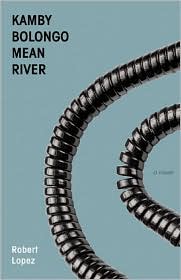

My Review of Robert Lopez’s Kamby Bolongo Mean River

Check out my review of Robert Lopez‘s Kamby Bolongo Mean River. Here’s an excerpt:

The absence of commas, colons, semicolons—actually all punctuation save the period, hyphen, and apostrophe—in Lopez’s novel makes for an oddball kind of rhythm where thoughts collide and then are abruptly stopped only to start again, like turning on a faucet and then quickly shutting off the valve, only to let it spurt out again. Ordinarily, Lopez’s constraints would result in suffocating prose, but instead, this dispensing of most punctuation, this stripping away of any inflection and any remotely flowery description, results in sentences that precisely limn the narrator’s consciousness, a narrator who would, given a chance, “rewrite the dictionary” because “[t]here are a lot of words in there [he doesn’t] like the definitions for.”

My Review of John Dermot Woods’s The Complete Collection of people, places, & things 

An excerpt from my review:

Woods’s puzzling stories bear some resemblance to the fabulist works of Augosto Monterroso and Eduardo Galleano, and kin to the fictions of Italo Calvino and Ben Marcus (albeit without Marcus’s energetic syntactical constructs). Can Xue’s elliptical narratives fit in here somewhere, too. But the book’s details, rendered in a deceptively simple but beguiling prose, makes for a bizarro world of its own. These are beautifully crafted stories, brimming with incisive wit, with an underlying philosophy underscoring the thrills and dangers of obsessions and compulsions, and the inevitable short shelf-life of any person, place, or thing, but also the revivifying power of collecting, as peculiar as it is profound. Also Woods’s drawings, brusque crosshatched renderings of each character, add another dimension to the book: each title page looks like a playing card with the passages following them feeling like the writing found on the playing card’s verso. The illustrations dovetail well with the idea that this book is another man’s collected works.

Check out the whole review here.

My Review of Michael Leong’s e.s.p.

Happy new year! Open Letters Monthly: an Arts and Literature Review has a new look for 2010 and my review of Michael Leong’s e.s.p. is in the latest issue. Here’s an excerpt:
In e.s.p., his latest collection of poetry, Michael Leong drafts a kind of architectonics of the page. By architectonics, I mean devices that reveal an overt consciousness of language’s status as language, words as building blocks, in which their form and shape and how they sit on the page and divide the surface plane are integral to their meaning. In the poem above, the phrases rock back and forth, mimicking birds in flight, while also suggesting a bristly nest. Though Leong’s poems often revel in the tactile aspects of words and letters, how sentences can visually suggest various structures, e.s.p. is no cold blueprint; Leong’s angular phrases, spiky forms, and playful compositions cavort within their spaces, prick consciousness as much as jar us from our sluggish thinking, and more importantly, rouse great feeling. Sentences, clauses, and assorted fragments here are used as scaffolds for a concatenation of ideas, the explorative range of which sets the mind aswirl. And while you must be careful not to judge a book by its cover, e.s.p.’s cover image—what looks like a blown-up etching from an old engineering handbook—is well-chosen. Its interplay of old communication technology with the personal intimacy of an outstretched hand simultaneously suggests incunabula and nostalgia while asserting authenticity and authority. It’s an appropriate image as the poems themselves often play with how technology and engineering intersect with intimacy.